PET Recycling in Pakistan (2026): Market Overview, Rates & Outlook
Pakistan discards enormous volumes of PET bottles every year — and a growing recycling industry is turning that waste into recycled PET (rPET) flakes for textiles, strapping, sheet and packaging. Here is how the market works, what drives the rates, and where it is heading.
Key takeaways
- PET (the plastic used for water and soft-drink bottles) is one of the most recyclable and most traded post-consumer plastics in Pakistan.
- The value chain runs from informal collectors and kabaris to sorters, balers, recyclers and finally manufacturers who buy rPET flakes.
- rPET flake rates in Pakistan track virgin PET and crude oil prices, the USD/PKR rate, flake quality, and contamination levels.
- The biggest domestic buyers are polyester fibre mills, strapping makers and sheet/packaging producers — with Punjab’s textile belt leading demand.
- Brand sustainability targets, EPR discussions and export demand are all pushing recycled-content demand upward.
Every day, millions of PET bottles are emptied across Pakistan — at homes, offices, hotels, weddings and roadside stalls. A large share is collected by an informal network of pickers and kabaris, but a meaningful volume still ends up in landfills, drains and waterways. For manufacturers, that discarded plastic is not waste at all: it is a reliable raw material once it is sorted, crushed and washed into recycled PET (rPET) flakes.
This guide explains the PET recycling market in Pakistan in plain language — what PET is, how the collection-to-flake chain works, who buys the output, what moves the price, and what the next few years are likely to bring.
What is PET, and why does it matter here?
PET (polyethylene terephthalate, resin code #1) is the clear, lightweight plastic used for beverage bottles and many food containers. It is prized in recycling because it can be mechanically reprocessed into clean flakes and re-used in fibre, strapping, sheet and packaging — often many times over. In a country that imports most of its polymer feedstock, every tonne of PET recycled at home is a tonne that does not have to be imported as virgin resin.
That combination — a genuinely recyclable material, strong domestic demand from textiles, and pressure on imports — is what makes PET recycling one of the more commercially sound corners of Pakistan’s circular economy.
How big is the opportunity?
Pakistan generates several million tonnes of plastic waste each year, and only a fraction is formally recycled; the rest is landfilled, burned or leaks into the environment. PET is a relatively small slice of total plastic by weight, but because it is clean, valuable and easy to identify, its effective recovery rate is higher than most other plastics — collectors actively seek out bottles because they pay.
The takeaway is not the exact percentages — it is the size of the gap. Every bottle that is currently landfilled or littered is potential feedstock. As collection networks formalise and more brands commit to recycled content, that gap is where the growth is.
The recycling value chain, step by step
Understanding who does what helps buyers and suppliers see where they fit:
- Collectors & kabaris — gather bottles from households, commercial points and waste streams.
- Sorters & balers — separate PET from other plastics, sort by colour, remove obvious contaminants and bale for transport.
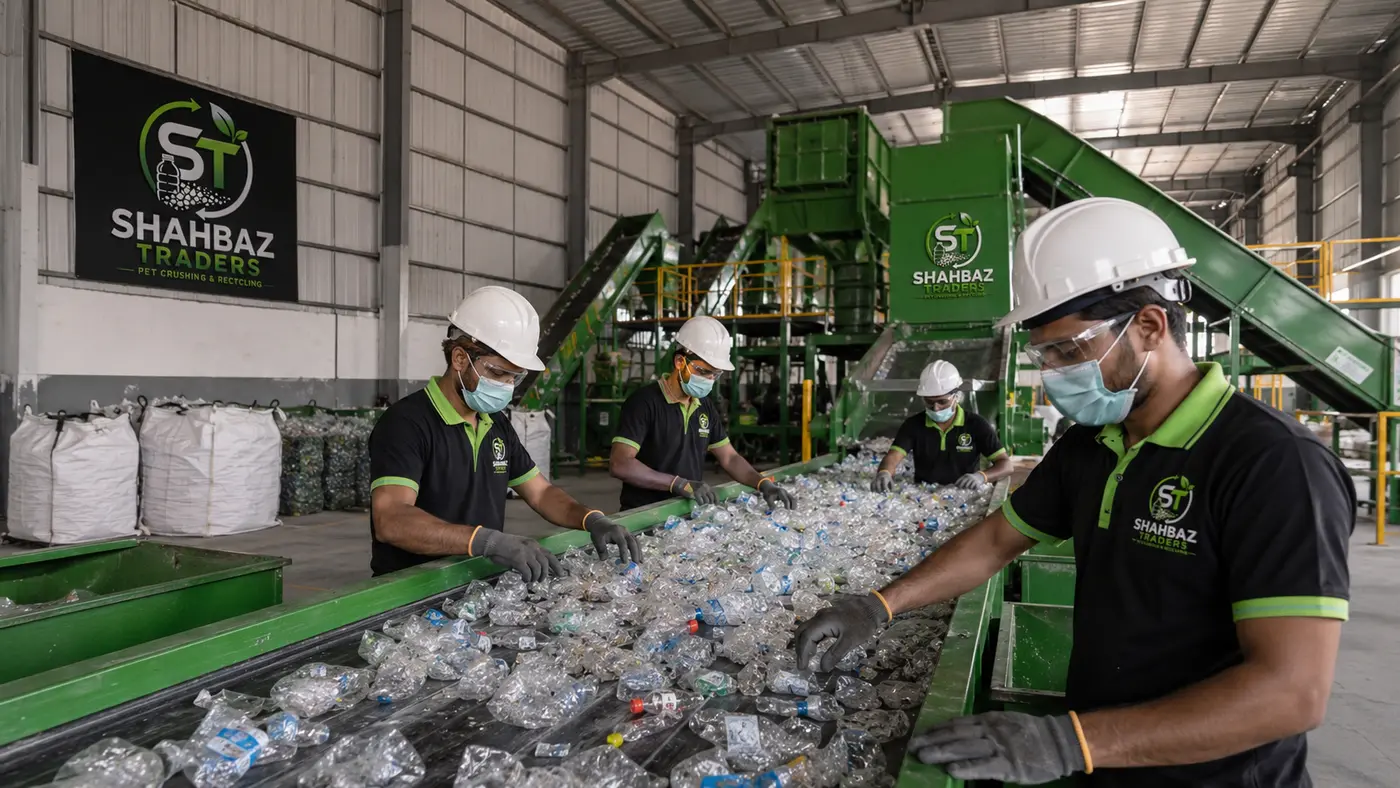
- Recyclers (crushers & wash lines) — granulate bottles into flakes and wash them (cold or hot) to remove glue, labels and residue. This is where Shahbaz Traders operates.
- Manufacturers — buy rPET flakes and convert them into polyester fibre, strapping, sheet and packaging.
A well-run recycler adds value at the middle of this chain: it pays suppliers fairly for bottles, and it delivers a consistent, documented flake that manufacturers can run without surprises.
Who buys rPET flakes in Pakistan?
Demand is concentrated in a few industries:
- Polyester staple fibre & filament — the largest consumer, feeding Pakistan’s huge textile sector (see our guide for fibre mills in the Faisalabad/Punjab belt).
- Strapping (PET straps) — used across logistics and packaging.
- Sheet & thermoforming — trays and packaging.
- Non-food packaging — bottles and containers for non-food uses.
Because so much demand sits with textiles, Punjab — and Faisalabad in particular — is the centre of gravity for rPET buying in Pakistan.
What drives rPET flake rates?
Recyclers and buyers both need to understand the levers behind the price:
- Virgin PET & crude oil prices — rPET is priced at a discount to virgin resin, so when virgin PET falls, rPET follows.
- USD/PKR exchange rate — virgin PET is import-linked, so a weaker rupee tends to lift local resin (and therefore rPET) prices.
- Flake quality & grade — hot-washed, low-moisture, colour-sorted flake commands more than cold-washed or mixed material.
- Contamination — PVC, PP/PE caps, labels and dirt reduce value quickly.
- Seasonality — bottle supply rises in summer; collection can dip in monsoon and winter.
We break the pricing mechanics down further in our upcoming pricing guide. For now, the rule of thumb is simple: cleaner, better-documented flake holds its value; contaminated material does not.
The real challenges
The industry is growing, but it is not without friction:
- Informal, fragmented collection — supply can be inconsistent in volume and quality.
- Contamination — mixed loads and non-PET material raise processing cost.
- Quality consistency — buyers need the same spec batch after batch, which requires disciplined sorting and washing.
- The food-grade gap — most domestic rPET is for industrial use; food-contact recycled PET needs a separately approved decontamination process (we cover this in Is recycled PET food-grade?).
The outlook
Three forces point the same way. Global and local brands are committing to recycled content in packaging and textiles. Conversations around Extended Producer Responsibility (EPR) are maturing, which would formalise collection and funding. And export demand for clean rPET flake gives well-run recyclers an additional outlet. For manufacturers, that means recycled raw material is becoming more strategic, not less; for suppliers of bottles, it means a durable market for what they collect.
Buying rPET flakes or selling PET bottles in Pakistan?
Tell us your volumes and requirements — we’ll put together a tailored quote fast.
Frequently asked questions
Is PET recycling profitable in Pakistan?
Who buys recycled PET (rPET) flakes in Pakistan?
What determines the price of rPET flakes?
Is recycled PET the same as food-grade PET?
General references: industry practice on PET mechanical recycling and rPET grading. Figures shown in the chart are illustrative for explanation, not official statistics.