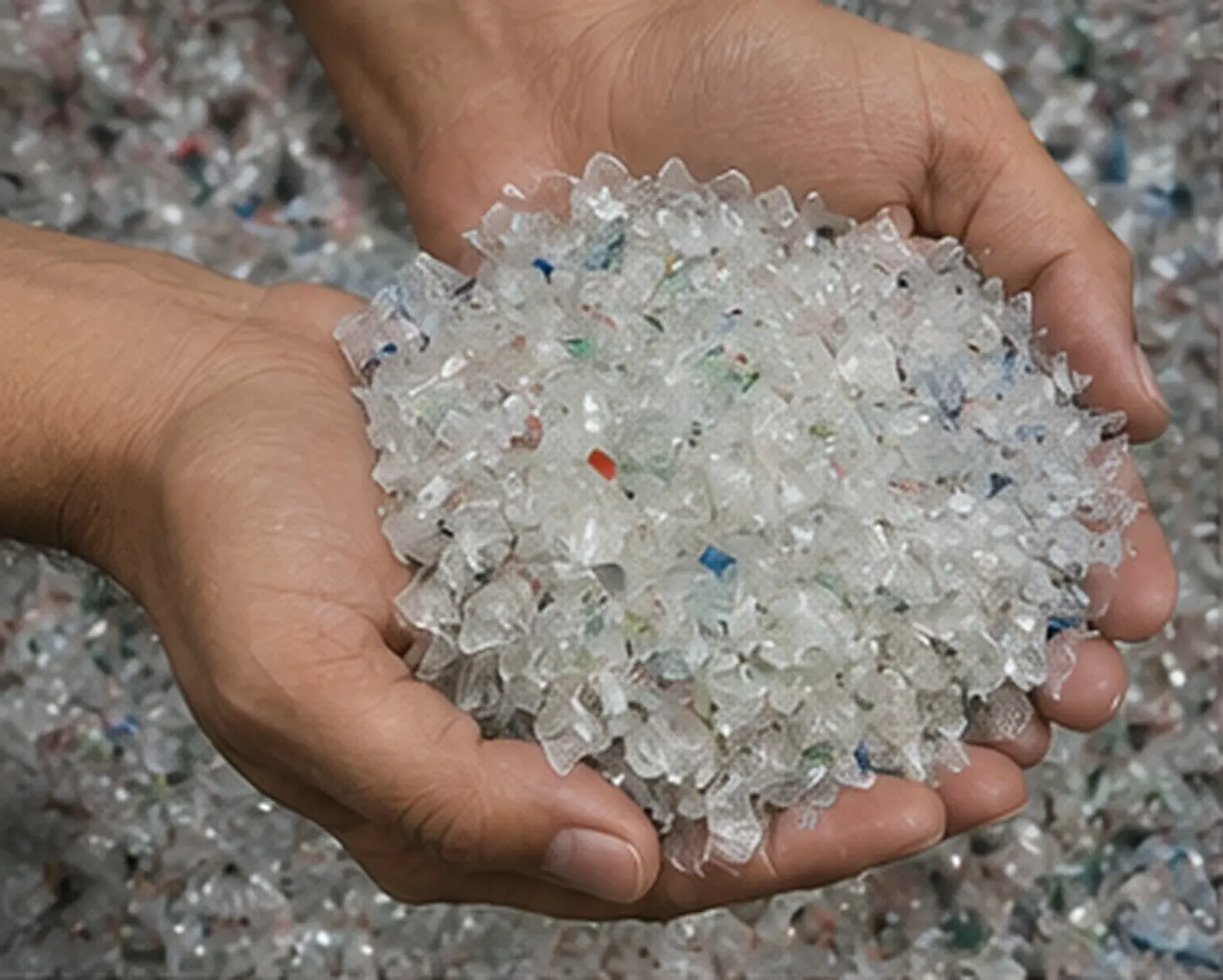
Key takeaways
- "Recycled" and "food-grade" are not the same thing.
- Hot-washing cleans the flake but does not make it food-safe on its own.
- The critical step is a validated high-temperature decontamination, proven by a challenge test.
- Approval is process-specific: EFSA opinion (EU) or FDA no-objection letter (US).
- If a supplier can't show that documentation, treat the material as non-food.
Why isn't washed rPET automatically food-grade?
Washing — even hot caustic washing — removes surface dirt, glue and oils, but it does not guarantee that trace chemical contaminants have been driven out of the polymer. Regulators judge food safety on the decontamination efficiency of the whole recycling process, not on how the flake was washed. That efficiency is demonstrated with a laboratory challenge test, where the process is run on PET deliberately spiked with surrogate contaminants to prove it can remove them to safe levels.
How is food-grade rPET actually approved?
- European Union (EFSA): the European Food Safety Authority assesses each recycling process and issues a scientific opinion; potential dietary exposure to contaminants must stay below a very low threshold. Approval is granted to the specific process, not to "recycled PET" in general.
- United States (FDA): the FDA reviews a process and, if satisfied, issues a "No Objection Letter" for using that recycled PET in food contact, subject to conditions.
In practice, food-grade rPET is usually produced through additional high-temperature steps (such as solid-state polycondensation, SSP) that both decontaminate the material and lift its intrinsic viscosity — a tier well beyond standard hot-washed flake.
What does this mean for buyers?
- If you make food or beverage packaging, ask specifically for food-contact-approved rPET and request the supporting FDA/EFSA documentation.
- For fibre, sheet, strapping and non-food packaging, high-quality hot- or cold-washed flake is the right, cost-effective choice.
- Don't rely on the words "food-grade" or "bottle-grade" without paperwork — verify the process approval.
Unless explicitly stated with supporting documentation, recycled PET flake — including hot-washed flake — is supplied for industrial, non-food-contact applications. Buyers are responsible for confirming suitability for their end use.
Frequently asked questions
Is recycled PET food-grade?
Not automatically. Recycled PET is only food-contact when it's produced by a process with an official positive safety assessment — an FDA No Objection Letter (US) or an EFSA positive opinion (EU). Otherwise it's for industrial, non-food use.
Does hot-washing make recycled PET food-safe?
No. Hot caustic washing removes surface contamination, but the critical step for food safety is high-temperature decontamination proven by a challenge test. Washing alone is not enough.
How is food-grade rPET approved?
Regulators assess the decontamination efficiency of the recycling process with a challenge test using surrogate contaminants. In the EU, EFSA issues an opinion; in the US, the FDA issues a No Objection Letter for that specific process.
Sources: Food Packaging Forum — EFSA criteria; EFSA Journal (2025) — PET recycling process assessment; Interplas Insights — FDA & EFSA food-grade resins.