Plastic Recycling & PET Collection for Lahore Businesses: Set Up a Buy-Back Loop
For Lahore businesses, the PET bottles you throw away are a missed opportunity. Setting up a simple collection and buy-back loop turns a disposal cost into a small revenue stream, cuts your footprint, and gets you ahead of tightening plastic-waste rules.
Business · 7 Sep 2026 · 10 min read
Key takeaways
PET bottles your business discards are a paid commodity — collecting them turns a disposal cost into income.
A buy-back loop also cuts your environmental footprint and strengthens your sustainability story.
It positions you ahead of Extended Producer Responsibility (EPR) and tightening plastic-waste rules.
Setting one up is simple: separate at source, store, and schedule pickups with a recycler.
Consistency is what makes it worthwhile — a steady stream earns better rates and reliable collection.
Most Lahore businesses treat empty PET bottles as waste — something to pay someone to take away. That’s a missed opportunity on three fronts at once: cost, revenue and reputation. Set up a simple collection-and-buy-back loop and the same bottles become a small income stream, a lower footprint, and a head start on rules that are only going to tighten.
This guide shows Lahore offices, hotels, factories, hospitals and housing societies how to make that switch — practically.
Why a buy-back loop makes business sense
Cuts disposal cost. Diverting PET from general waste reduces what you pay to have it hauled.
Adds a small revenue stream. Recyclers pay for clean PET — so your waste starts earning.
Lowers your footprint. Every bottle recycled is one diverted from landfill or drains — a real, local environmental win in Lahore.
Strengthens your brand story. “We recycle our PET” is a credible, verifiable claim you can share with customers and partners.
Gets you ahead of regulation. As Extended Producer Responsibility (EPR) and plastic-waste rules mature, businesses already recycling will be ahead of the curve.
What a PET buy-back loop delivers for a Lahore business (illustrative)Illustrative benefit mix — varies with how much PET your business generates.
How to set one up — step by step
Separate at source. Place clearly-labelled PET-only bins where bottles are used — canteens, meeting rooms, guest areas, production floors.
Keep it clean and dry. Empty bottles, avoid mixing food waste; cleaner material earns a better rate.
Store & (if possible) compact. A simple storage point — and baling if you have volume — cuts transport cost and lifts your rate.
Schedule pickups. Agree a weekly or monthly collection with a recycler who weighs transparently and pays promptly.
Track it. Record the weights and payments — useful for both finance and your sustainability reporting.
Turning volume into a better deal
The economics improve with scale and consistency. A one-off bag is welcome, but a steady, sorted stream earns priority collection and better pricing, because it lets the recycler plan logistics. If your Lahore operation generates meaningful PET — a hotel chain, a large office, a factory canteen, a society — a scheduled buy-back arrangement is where the real value is. And because buy-back rates move with the recycled-flake market, a reliable partner will keep you informed on the trend so you understand your payments.
The bigger picture
Pakistan generates large volumes of plastic waste, and only a fraction is formally recycled. Businesses that build collection into their operations aren’t just saving money — they’re part of closing that loop locally. For the market context, see PET recycling in Pakistan, and for the supplier mechanics, how to sell PET bottles.
Want to set up PET collection for your Lahore business?
Tell us roughly how much PET you generate and how often — we’ll advise on preparation and set up a scheduled buy-back with transparent weighing and prompt payment.
Yes. Clean post-consumer PET is a paid commodity. By separating and collecting it, a Lahore business can turn a disposal cost into a small, steady revenue stream while cutting its footprint.
How do I start a PET collection loop?
Separate PET at source into labelled bins, keep it clean and dry, store (and compact if you can), and schedule regular pickups with a recycler who weighs transparently and pays promptly.
Does recycling PET help with regulations?
It positions you ahead of Extended Producer Responsibility (EPR) and tightening plastic-waste rules — businesses already recycling will adapt more easily as requirements formalise.
Do recyclers collect from businesses in Lahore?
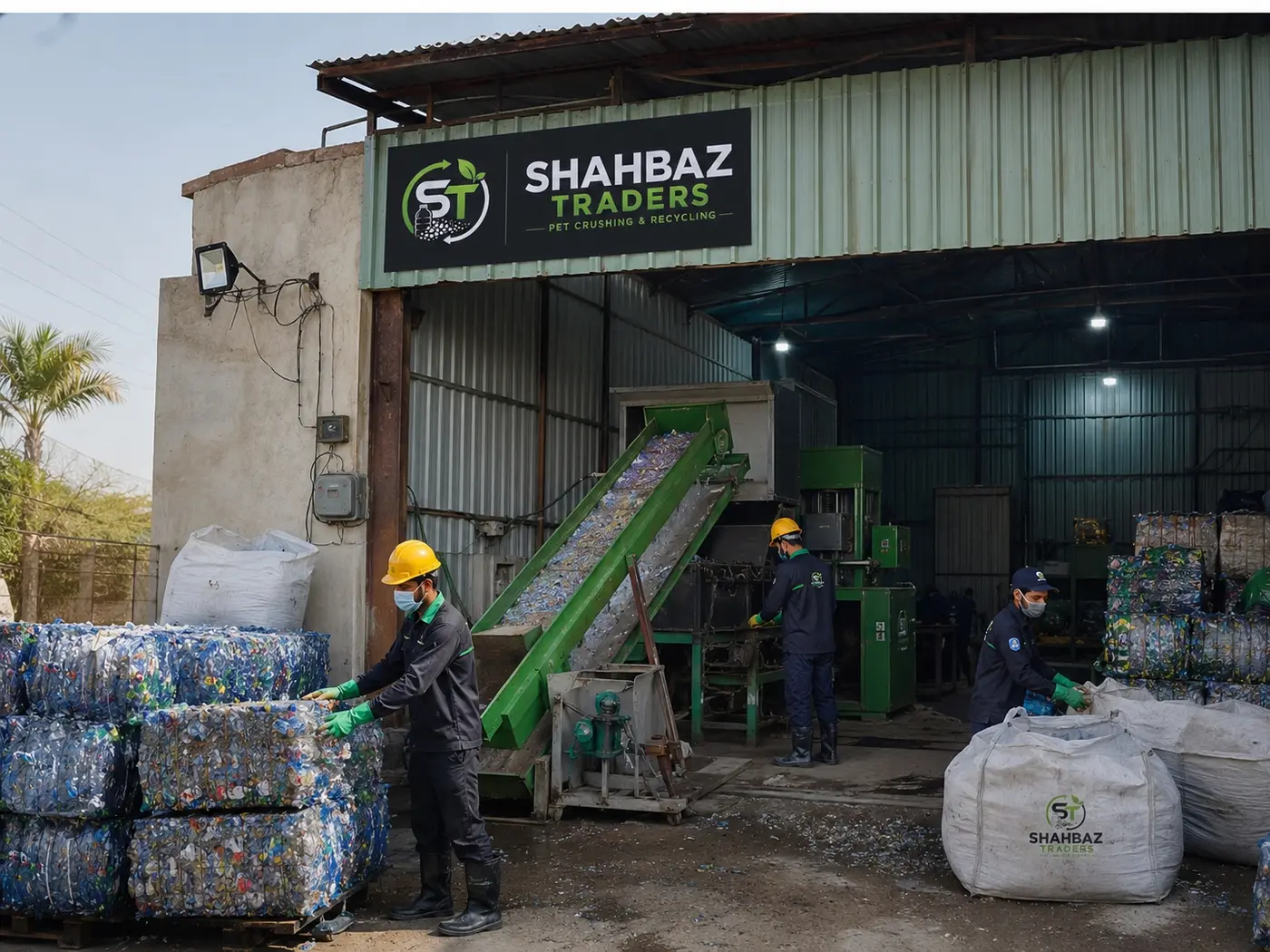
Yes — Shahbaz Traders arranges scheduled collection for suitable volumes across Punjab, including Lahore, with transparent weighing and prompt payment.
Reflects standard practice for business PET collection and buy-back. Chart values are illustrative.